Introduction
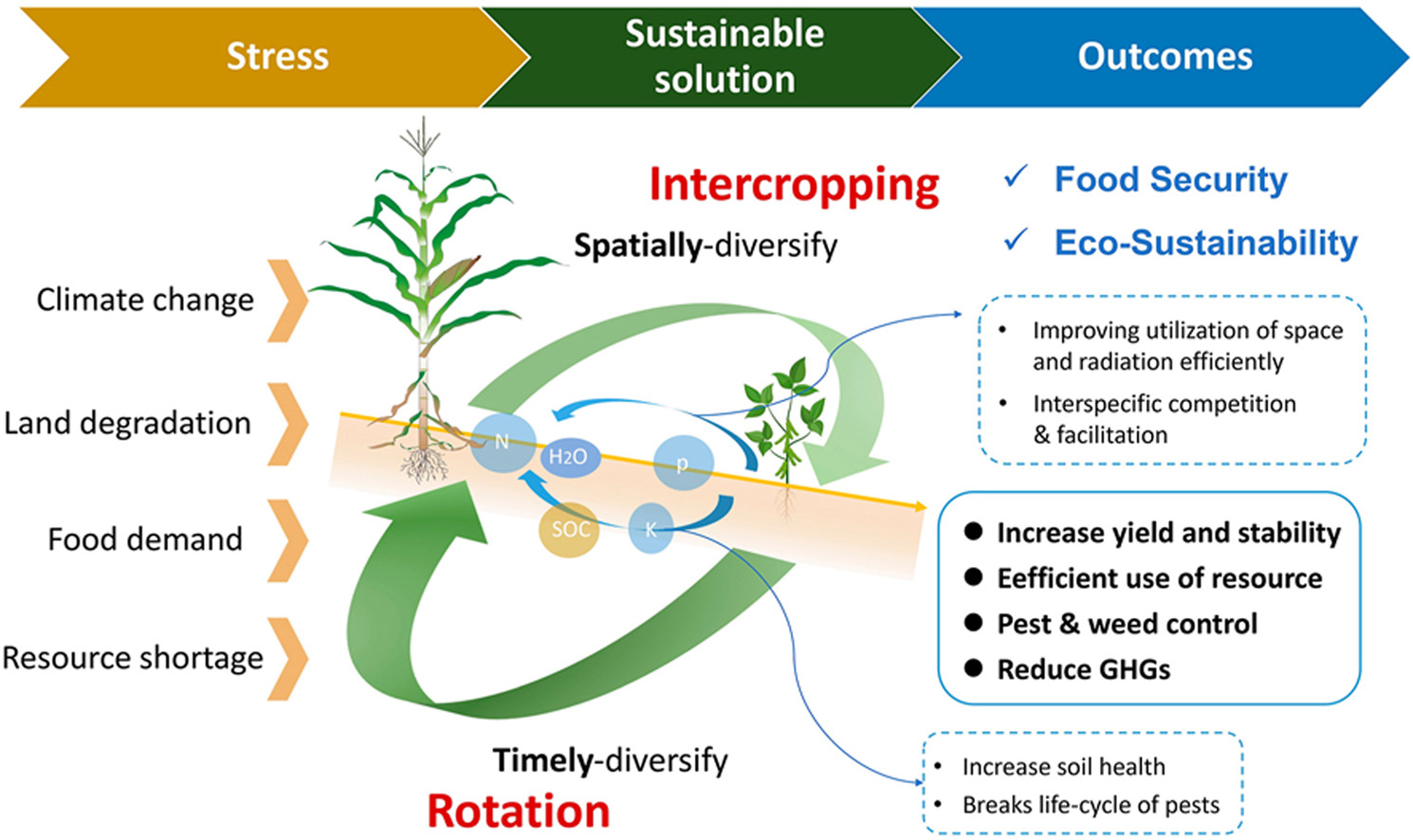
Hunger continues to be a pervasive problem throughout the world, with 193 million individuals across 53 countries/territories experiencing profound food insecurity (UN, 2022), and the situation is expected to be intensified by the increasing global population. In order to meet the urgent demand for calories and nutrients, agricultural production will need to increase by 70% or more (FAO, 2018). The Asian green revolution as an innovation of intensive agriculture has trebled grain yields, but brought soil degradation, increased risk of pest and disease outbreaks, and environmental pollution since it increased the application of fertilizer, pesticide, irrigation and agricultural machinery (Snapp et al., 2010). Future agriculture is expected to address simultaneously several intertwined challenges through increased productivity, reduced environmental impact and enhancement in climate change adaptation and mitigation (Raseduzzaman and Jensen, 2017; Wei et al., 2023). Crop rotation (temporal diversification) and intercropping (spatial diversification) strategies have been proven to improve agricultural sustainability (Li et al., 2021a, Li et al., 2021b), providing a tradeoff between crop productivity and other ecosystem services (Rockström et al., 2017; Martin-Guay et al., 2018; Mingotte et al., 2021).
Globally, maize is grown in a large area (197.23 Mha), accounting for 30% of the food supply in the Americas, 38% in Africa and 6.5% in Asia, and is a major contributor to local food security (Prasanna et al., 2020; Tripathi et al., 2021). Besides being a major source of food and feed for humans and animals, it is also a potential source of bioenergy (Erickson and Berger, 2013). Additionally, legumes are rich source of protein and has a high market value (Ainsworth et al., 2012; Chimonyo et al., 2019). Global demand for legumes, especially soybeans, has exploded in recent decades due to their use as a feedstock for soy–animal feed, biofuels and vegetable oil (Ritchie et al., 2023). In order to meet production needs, land expansion for soybean production has increased by 160% in Brazil and 57% in Argentina, and much of this expansion has come at the cost of deforestation. By 2016, 9% of the continent’s forests were converted to soybeans (Song et al., 2021; Chen et al., 2022). Among the UN sustainable development goals (SDGs), mitigating climate change and biodiversity loss to achieve zero deforestation is prominent in the global supply chains of commodities such as palm oil and soybeans (Song et al., 2021).
The combination of intercropping and crop rotation of maize and legume has emerged as a promising agricultural practice that can improve yields and soil health while reducing the environmental impact of conventional farming practices. For example, the maize-soybean intercropping-rotation model in China can achieve maize yields comparable to those of monoculture maize system while additionally harvesting a season of soybeans, with an experimental land-equivalent ratio of 1.4 (Du et al., 2018). As a result, intercropping and rotation of crops have received a lot of attention in scientific and technological circles and are also promoted by the Central No.1 document of China in 2022 (State Council of CPC, 2022).
The objective of this study is to improve our understanding of how different historical breakthroughs in agriculture such as the Green Revolution etc. have influenced the research efforts on maize-legume intercropping and crop rotation, and whether the most traditional cropping systems align with the world’s need for future sustainable agriculture. For this purpose, we use bibliometric analysis to identify research hotspots, trends, and gaps in maize-legume intercropping and rotation over the past 30 years. We also provide a systematical comparison of the development history and patterns of intercropping and crop rotation systems. As a transition towards sustainable agriculture, our systematic mapping of promising cropping systems might be valuable for inspiring and informing countries and regions facing food and environmental insecurity, and consequently offers a possible direction for global sustainable development.
Section snippets
Methods and data
Bibliometrics is an interdisciplinary that uses mathematical and statistical methods to quantitatively analyze all carriers of knowledge in a field of interest (Donthu et al., 2021), to help understand the prospects and characteristics of the field.
Results
Based on the bibliometric analysis of the maize-legume intercropping and rotation research, the prominent countries/regions, research areas, and keywords in this field are highlighted. The data is analyzed and discussed in detail to provide a comprehensive and systemic understanding of the research progress and trends.
Benefits of Intercropping and crop rotation
Intercropping and crop rotation have the potential for a beneficial balance, providing ecosystem services while increasing yields, which makes them promising practices that can contribute to ecological (or eco-functional) and sustainable intensification on crop production. A decade-long monitoring study revealed that maize-legume intercropping systems, on average, outperformed monoculture by 22% in grain yield (Li et al., 2021a). Similarly, rotation has shown the potential to boost yields by
Conclusion
This study analyzes the developing pattern and trend of maize-legume intercropping and crop rotation based on bibliometric analysis. Based on a long-term review of their application, we observe a new climax driven by global sustainable development. For the spatial distribution, maize-legume intercropping research is dominated by developing countries (smallholder agriculture), represented by China, while crop rotation research is dominated by developed countries (large-scale farms), represented
Funding
This work was supported by the National Key Research and Development Program of China (2022YFF1003500; 2021YFF1000302; 2021YFD1200700), Science and Technology Innovation 2030- Major Project, 2022ZD0400607, Beijing Nova Program (20220484114), and Foshan Municipal People’s Government Special Fund Project for Scientific and Technological Innovation (BK22BE013).
CRediT authorship contribution statement
Yilin Zhao: Data curation, Methodology, Validation, Writing – original draft. Songhao Guo: Formal analysis, Methodology, Software, Visualization. Xueqin Zhu: Conceptualization, Writing – review & editing. Lei Zhang: Writing – review & editing. Yan Long: Funding acquisition, Project administration, Supervision. Xiangyuan Wan: Funding acquisition, Project administration, Supervision. Xun Wei: Conceptualization, Funding acquisition, Project administration, Supervision, Writing – original draft.
Declaration of competing interest
The authors declare that they have no known competing financial interests or personal relationships that could have appeared to influence the work reported in this paper.